Newsletter Subscribe
Enter your email address below and subscribe to our newsletter

 ByDiana
Most of us have a plan for our dogs when we’re going to be gone for a long time. We arrange for a pet sitter, ask a family member to stop by, or make sure someone knows when we’ll be home.
But what about the ordinary times?
You run to the grocery store. You meet a friend for lunch. You drive across town for an appointment. You expect to be home in a couple of hours, so your dog is perfectly comfortable snoozing on the couch waiting for you.
Then something happens and you can’t get home.
Maybe your car breaks down. Bad weather closes a road. You become ill while you’re out. An appointment unexpectedly turns into a trip to the hospital.
Most of us don’t like thinking about those possibilities. But there’s one question every dog owner should probably be able to answer:
If I couldn’t get home tonight, who would know my dog was there waiting for me?
This post contains affiliate links. If you make a purchase or sign up through one of these links, we may earn a commission at no additional cost to you.
Preparing for an unexpected absence doesn’t mean expecting something bad to happen.
It’s simply another way of taking care of the dog who depends on you.
Start by choosing at least one trusted person who could step in if necessary. Ideally, have a backup person too. This might be an adult child, neighbor, close friend or relative who knows your dog and would be comfortable caring for them.
Make sure those people know they’ve been chosen. An emergency isn’t the best time for someone to discover they’re your dog’s backup caregiver.
And there’s another important question:
Could they actually get into your house?
A trusted person may know exactly what your dog needs, but that doesn’t help much if they’re standing outside a locked front door.
A spare key, secure lockbox or another safe access arrangement can make an enormous difference.

You probably don’t have to think about how much food your dog gets or which medication goes with dinner. You’ve done it hundreds of times.
Someone stepping in unexpectedly won’t know those things.
Create a simple written list that includes:
Keep a copy somewhere easy to find and give one to the people you’ve chosen.
If something changes, update it.
That ten-minute job could save someone hours of confusion during an emergency.
Your emergency plan should also account for the possibility that your dog gets outside.
A collar with current identification is one of the simplest protections you can provide. If your dog is microchipped, make sure the registration information stays current too.
Technology has also created additional identification options, including QR-code tags that can provide a finder with information by scanning the tag with a phone.
The important part isn’t having the fanciest technology. It’s making it as easy as possible for someone who finds your dog to reach you or another responsible person.
You can leave instructions.
You can give someone a key.
You can choose wonderful backup caregivers.
But there’s still a problem:
How will they know you didn’t make it home?
If you’re supposed to be away for a week, someone is probably already caring for your dog.
The bigger concern is the completely ordinary afternoon when nobody expects anything to be wrong.
That’s what caught my attention about a service called Pangel.
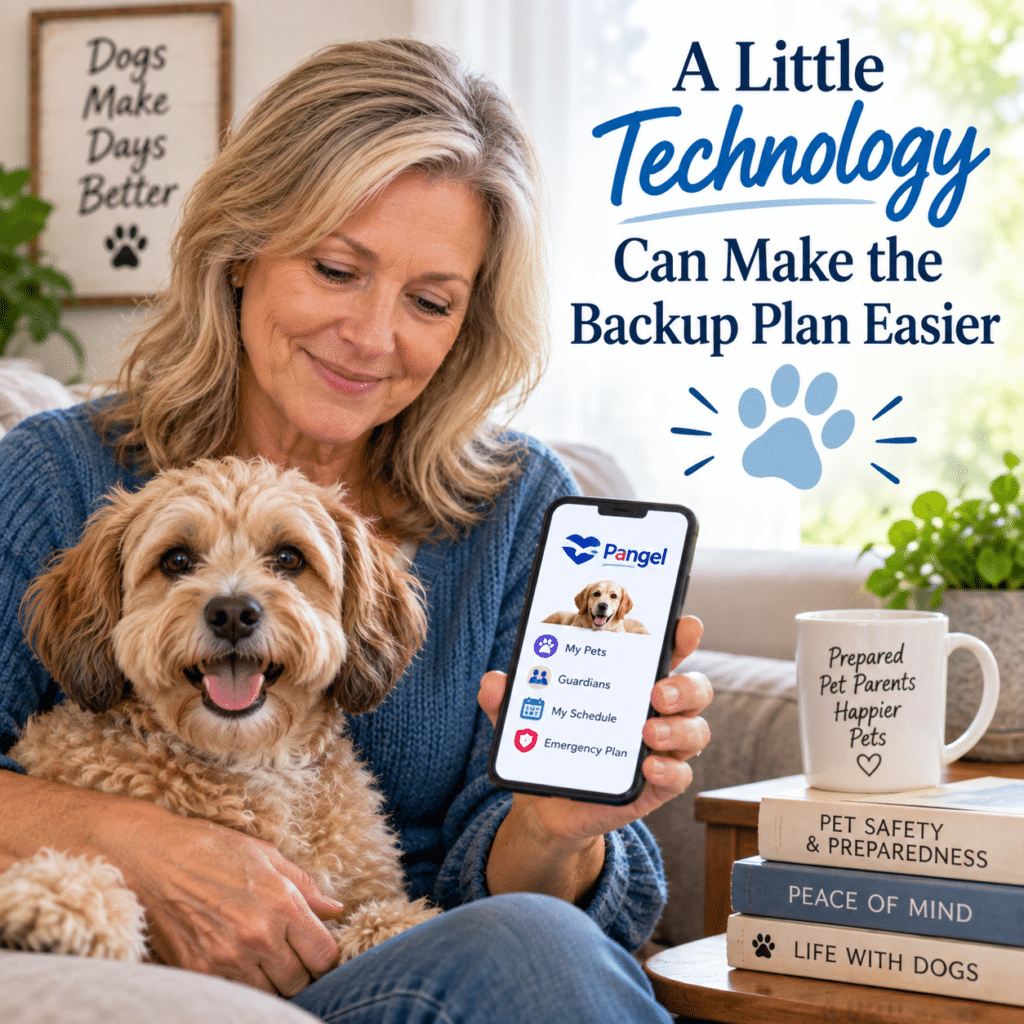
Pangel is designed for pet owners who leave their pets at home and want a backup plan in case something unexpectedly prevents them from returning.
You create a profile containing information about your pets and choose trusted people to serve as guardians. Before leaving home, you tell the app when you’re leaving and when you expect to return. Pangel’s current terms say subscribers must manually activate their schedule and update or deactivate it as appropriate; the service does not automatically determine whether you’ve returned based on your location.
Your pet profile can include information about your dog’s needs and veterinarian. Pangel’s terms currently require at least two guardians for each pet, and those guardians must be adults and agree to the role.
This isn’t meant to replace a pet sitter when you knowingly plan to be away. In fact, Pangel specifically states that it is not a pet-sitting service, nor is it a personal-safety service or a substitute for emergency services. Think of it instead as another layer in the emergency plan you’ve already made for your pets.
Pangel currently offers a 14-day free trial, which gives you a chance to see whether the system makes sense for your household.
👉 [Try Pangel Free for 14 Days]
Pangel offers an optional QR-code pet tag as another part of its pet-safety system.
If someone finds your dog, they can scan the QR code without downloading an app. The tag connects the finder with the owner’s contact information so they can call directly. Pangel says the owner also receives an alert with the location when the tag is scanned.
The company’s website currently lists the tags at $15.99 including postage and says they’re shipped to U.S. addresses.
You don’t necessarily need a QR tag to have a good lost-dog plan. Traditional ID tags and a properly registered microchip remain important options. What matters is making sure that if your dog gets away, whoever finds them has a practical way to help get them home.

An emergency plan isn’t just food, water and keys.
Consider how your dog would react if someone unexpectedly entered the house.
A friendly dog might greet your neighbor like they’ve been waiting all afternoon for company.
A nervous dog might hide.
Another might try to bolt through the open door.
Your backup caregiver should know those things ahead of time.
If your dog needs a special harness for walks, won’t take medication unless it’s hidden in cheese, is afraid of thunderstorms, guards food, or shouldn’t be around other dogs, write it down.
Those little details are everyday knowledge to you. During an emergency, they become important instructions.
Hopefully, you’ll create an emergency plan for your dogs and never need to use it.
That’s the best possible outcome.
But knowing that someone could get to your dogs, feed them, give them their medication and keep them safe if you unexpectedly couldn’t get home provides a kind of reassurance that’s hard to put a price on.
Pangel itself was inspired by a similar question. Its founders say they narrowly avoided a serious accident while driving to an airport and afterward found themselves wondering what would have happened to their dogs if they hadn’t returned home. That experience eventually contributed to the creation of the service.
You don’t need an elaborate emergency system.
You need a person, a way for that person to get inside, clear instructions, current identification, and a reliable way for someone to realize your dog needs help.
That’s a pretty good safety net for the family member who’s always waiting for you to come through the door.
👉 [Learn More About Pangel and Start the 14-Day Free Trial]